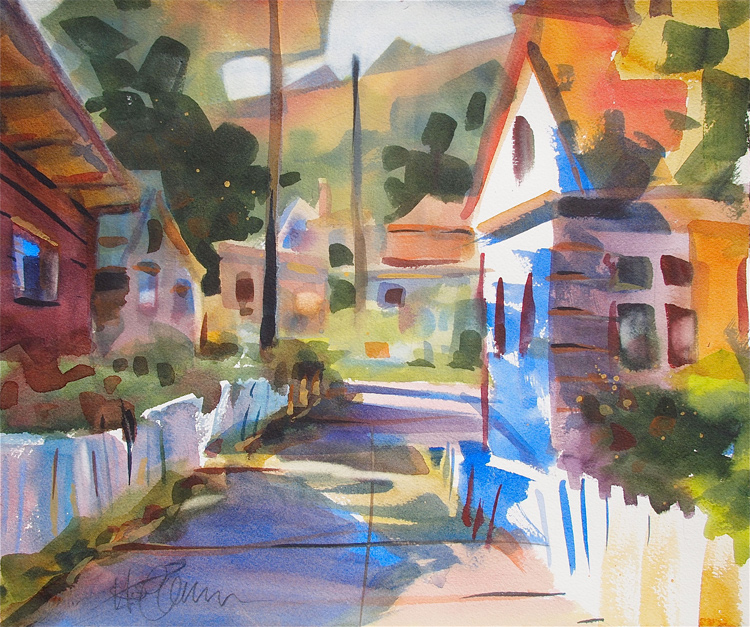
Sketching
Sketching before you paint reduces decision-making while painting.
There is no line in nature, yet sketchbook is all about line.
Sketch only the most important movements
Open up sketches to allow “passage” [linkage]
Side lighting creates a connecting large shadow shape that pulls sketch together.
Save whites.
Must improve your drawing to improve your watercolor.
 |
Ways to Sketch
Information sketches – not necessarily painting ideas.
Value sketch – we are drawn to strong value contrasts.
Speed Sketching – put down shadow first [value first] then line; this is usually all you need for watercolor
Sketch with ink, and one direction shade lines – you will get better faster
Line, add a dark rectangle [to bring out a portion, but not necessarily all, of foreground]
Line … and value
Light against dark or dark against light
Line and shading
Pure fun
|
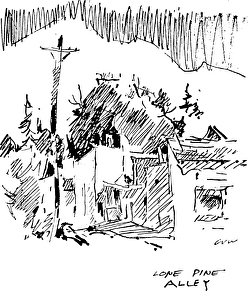
"Lone Pine Alley" sketch by Chris van Winkle
Planning Your Painting
Design with the fewest possible lines
Try for a simple exaggerated likeness, a caricature of the scene.
Eliminate the fussy, fuzzy, inconsequential. What remains is the essence of the place.