YouTube Video Lectures

Notan: Japanese Design Principle of Light and Dark
Web page Tutorials
 Notan: The Dark-Light Principle of Design

You can view/download a PDF from the Gutenberg Project here
You can buy it from Amazon here:
- Notan - Exploring Shape and Composition by Mitch Albala
- A Guide to Notan: The What, Why and How by Barry John Raybould
- Notan Painting: What it is and How to Use it
- Quick Tip on Notan by Kelley Sanford
Tutorial Videos
- Creating a Strong Focal Point in Watercolor by Laurel Hart
- Notan - Exploring Shape and Composition by Mitchell Albala
- Painting Lesson - Notan by Richard Robinson
- Part1: Shapes and Two Value Notan Drawings by Malcolm Dewey
- Jane Appleby - Lighthouse Park - Notan Sketch by Jane Appleby
- Quick Tip 11 - Notan Lift-Out by Dianne Mize
- Environment Design Week01 Demo: Notan and Composition Design by Amit Dutta
- Quick Tip 44 - Composing Notans by Dianne Mize
Books
You can buy it from Amazon here:
Sketching with the Brush, Growing Silhouette Shapes and Drawing Shadows
Marc Taro Holmes
Montreal artist, Marc Taro Holmes is the author of three books on art-making.
- The Urban Sketcher: Techniques for Seeing and Drawing on Location (2014)
- Designing Creatures and Characters: How to Build and Artist’s Portfolio for Video Games, Film, Animation and More (2016)
- Direct Watercolor (2018)
Marc has been a correspondent and volunteer art instructor with urbansketchers.org, and, served as a board member and volunteer editor from 2009-2016. He was elected to the Canadian Society of Painters in Watercolor in December of 2016, recently winning their Sloan Award (2016), and CSPWC Second Prize Award (2017), and most recently, being juried into an exhibition-exchange with the Société Française de l’Aquarelle. (2018).
Marc graduated in 1995 with a BFA from the Alberta College of Art and Design in Calgary Alberta, and has worked for studios including Electronic Arts, Microsoft, and Disney.
Website
Video Tutorials
- Sketching with the Brush
- Growing Silhouette Shapes and Drawing Shadows with Marc Taro Holmes
- Manchester Urban Sketchers Symposium
- French Church Painting by Anne-Laure Jacquart
- Sketching with the Brush / Watercolour Figures by Trevor Waugh
- Without Sketch Landscape Watercolor - Relax Time by Korean painter Nam-il
- Butterflies, Flowers w/ Intuitive Brush Strokes, no sketching by Angela Fehr
- Colour Washed Tulip Exercise Watercolor paper by Angela Fehr
PDFs
Book Review of Marc's first Book
Sketching and Planning
According to Chris Van Winkle as described at: Keene Wilson's Insights of the "California School of Watercolor"
Sketching
Sketching before you paint reduces decision-making while painting.
There is no line in nature, yet sketchbook is all about line.
Sketch only the most important movements
Open up sketches to allow “passage” [linkage]
Side lighting creates a connecting large shadow shape that pulls sketch together.
Save whites.
Must improve your drawing to improve your watercolor.
 |
Ways to Sketch
Information sketches – not necessarily painting ideas.
Value sketch – we are drawn to strong value contrasts.
Speed Sketching – put down shadow first [value first] then line; this is usually all you need for watercolor
Sketch with ink, and one direction shade lines – you will get better faster
Line, add a dark rectangle [to bring out a portion, but not necessarily all, of foreground]
Line … and value
Light against dark or dark against light
Line and shading
Pure fun
|
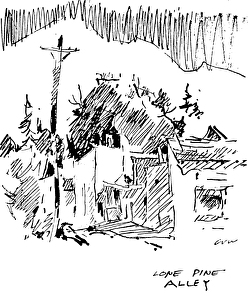
"Lone Pine Alley" sketch by Chris van Winkle
Planning Your Painting
Design with the fewest possible lines
Try for a simple exaggerated likeness, a caricature of the scene.
Eliminate the fussy, fuzzy, inconsequential. What remains is the essence of the place.
Subscribe to:
Posts (Atom)

-
This week I experimented with revisiting negative painting with a fine mist spray bottle in our treatment of florals. For many of you the e...
-
 Week 6: Color Theory and Mixing; Whitney's Allover Pattern, Part 2 Local, Atmospheric, Light/Shade Harmonic...
-
Introduction A little history of one period of watercolor, the "California School" of Watercolor, which thrived between the mid-...
